On The Individual
The power of greatness that comes from a single person finding their solitude
The Heroic Ideal
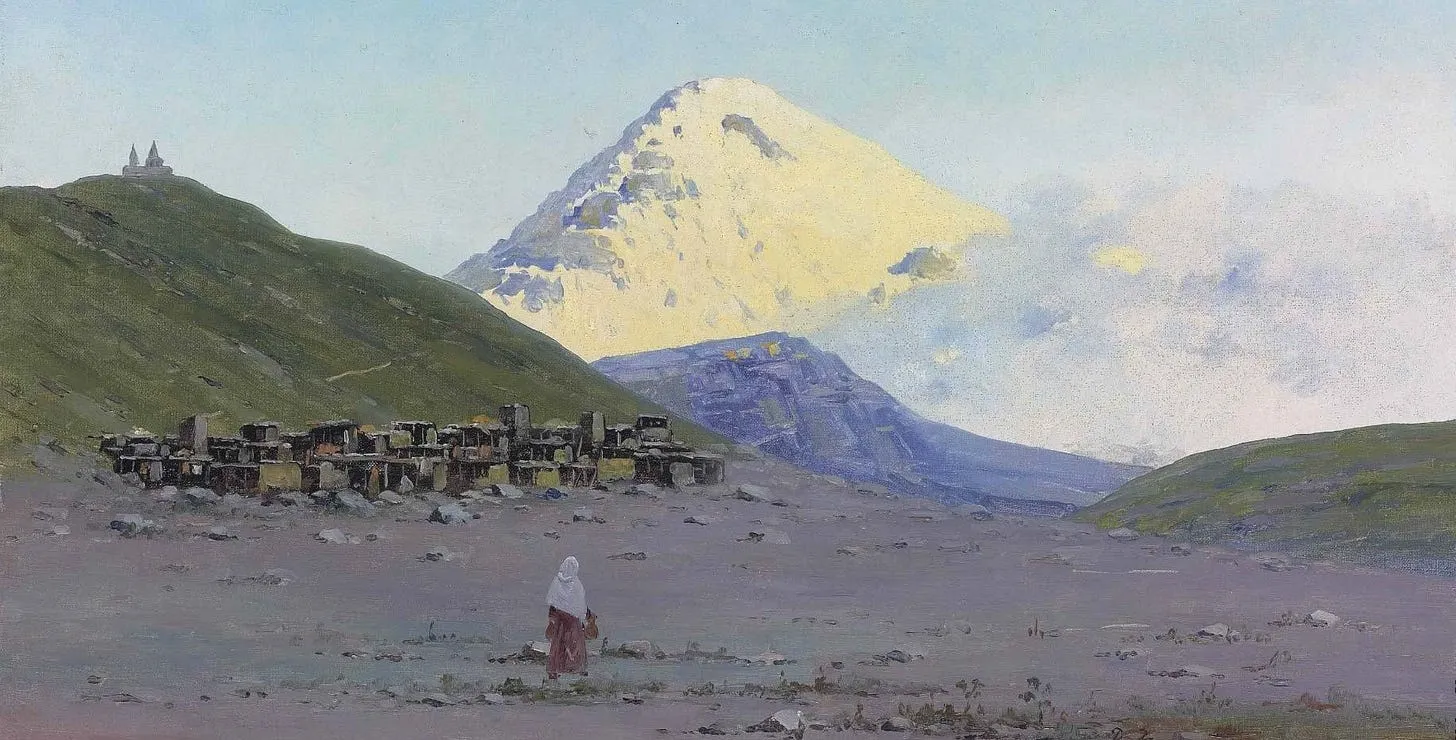
Friedrich Nietzsche starts his story about the hermit Zarathustra on a mountain. Zarathustra spent ten years of solitude there, with his animals and a cave of his own. He spent this time contemplating about his life, finding out what beliefs sit deeply inside him, and came back to bring the people his ideas. They rejected him, just a few followed him but tried to idolize him, and ultimately, he realized that the man of the future, the Übermensch, will not come for a long time. He saw the last man, the counterpart to the Übermensch. A person of mediocre lifestyle, lacking inspiration, the ultimate nihilist. He does not create or strive, does not ask the important questions of life, and without the drive to overcome oneself and create new values, humanity doesn't collapse dramatically — it just shrinks into satisfied, blinking contentment. Nietzsche saw what would ultimately come: The numbness of society. Numbed down by gossip, hedonist actions, and popular culture stripping any inspiration from the common man. Today this image fits better than ever before. People have no time for contemplation any longer, no time without a screen in front of them, and are anxious to be alone with their thoughts. I wrote about this in my previous essay, but this time I want to present what a true individual, someone who does not comply with the corruptive void of modern society, looks like. The heroic ideal of individualism is best portrayed in individuals who conquer the world, not by force and with the intention to take over and rule, but to change something, to leave a dent in the universe, basically to leave a mark in this world and not vanish like the last men in a mere whisper of complaint.
The best example for such people are the technologists of our modern times. I’m starting with the most obvious one, the one who thought different: Steve Jobs. There is a famous quote from one of Apple’s advertisement campaigns:
Here’s to the crazy ones. The misfits. The rebels. The troublemakers. The round pegs in the square holes. The ones who see things differently. They’re not fond of rules. And they have no respect for the status quo. You can quote them, disagree with them, glorify or vilify them. About the only thing you can’t do is ignore them. Because they change things. They push the human race forward. And while some may see them as the crazy ones, we see genius. Because the people who are crazy enough to think they can change the world, are the ones who do.
After reading ‘Thus Spake Zarathustra’ by Nietzsche and coming up to this quote again I realized how glorious this single person was. Steve Jobs did not give a fuck, and he also did not do everything in his power to help humanity. That’s a common misconception. Of course he would say that Apple products are designed for creative people, but one incident remarks on how egoistic Jobs really was. When he was listening to some music on his Discman, he got so annoyed by the skipping CD and the poor design that he got angry, trashed that thing away, and declared that he would build something himself that is better. We got the iPod in the process. Not because Jobs wanted to gift portable music to the world and make a profit in the process, but because he himself wanted to have that thing. Another example is Linus Torvalds. I’m not going to talk about the Linux operating system, which in itself is a product of mastery, but a similar incident as with Steve Jobs getting annoyed by something poorly designed. Torvalds was using BitKeeper to track changes in the Linux kernel code and organize versioning, code control, and whatever you would expect of … Git, which he invented after being severely annoyed by the producer of BitKeeper as they pulled free licenses from the Linux team. Another example of a single person gifting the world a great tool not because of their love for the people, but because of their own egoism and desire to have something better themselves. You could even say that the iPod and Git are byproducts of egoist inventors.
Egoism vs Egotism
I declared Jobs and Torvalds as egoist. That may sound harsh, but it is true. They built those things in their own interest, not to benefit any shareholders or fulfill the altruist purpose of advancing humanity, but because they deeply wanted those things themselves. There is a strict differentiation between what people often misinterpret as ‘evil egoism’ and the actual definition of egotism. Egoism in itself means that someone acts in their own self interest, not to harm or disadvantage others, but because they are individuals that seek to life a happy life. What Jobs and Torvalds, and many other egoist inventors pursued, was ‘ethical egoism’. This is defined by the view that self-interest is the proper motivation for action, which was true in their case. Another example of this would be your daily life as in taking care of yourself. Basic hygiene, eating, making money to pay rent. All of those are egoist, because they are the natural response to keep your own life worth living, to make it better, and to progress towards happiness. What people miss to realize is that their definition of ‘bad egoism’ is actually defined as egotism. Egotism is morally bad, and a personality trait. It is defined by an inflated sense of self-importance, excessive talking about oneself, or conceit. An egotist person would be someone like Jeff Bezos, or Donald Trump. Excessively talking about themselves, their great achievements, no sense of down-to-earth, and ultimately in the belief that they are better than others because of their acts and person.
Not every egoist is an egotist, as Jobs and Torvalds certainly did not brag about their greatness or tried to throw the biggest parties to show off their wealth and status. And not every egotist is an egoist, as there are certainly people from the altruist spectrum that can’t stop talking about their achievements for the working class, how they help poor people by buying socks, or how they give away all their fortune to help drug addicts. Those are not necessarily bad acts, but bragging about them and only doing them to give yourself status and social acceptance is certainly egotist. The heroic individual is not vain, they are principled. Torvalds is famously abrasive but produces extraordinary work.
Who is John Galt?
Another great example of this heroic ideal put into perspective are the works of Ayn Rand, specifically ‘Atlas Shrugged’ and ‘The Fountainhead’. Her characters are individualists who defy any social norm for altruist expectations. Hank Rearden, Howard Roark, John Galt … they all create their work because of their own self-interest. They don’t care for the opinion of others, and would rather die than giving their precious invention to the socialist claws. They are my favorite prime example in fictional literature of the egoist individual thinking first of his own benefits and giving to humanity something in exchange where they commercialize their ideas. Ayn Rand created the philosophy of Objectivism around these ideals, that one has to think of his self-interest first and everyone will benefit later. Imagine people like Jobs or Torvalds being put into a team where they had to come up with these ideas by force, or accept compromise by others. They would have rather quit and abandoned the idea than compromising. In one instance, when the engineering team of the early prototype of the iPod declared that the product cannot be made slimmer, Jobs famously threw the prototype into an aquarium and upon seeing air bubbles coming out it stated “see, air bubbles – make it smaller”. Ayn Rand would have loved this man since her fictional characters are of the same egoist ruthlessness.
Hank Rearden, inventor of Rearden Steel, a new metal that is stronger and cheaper than ordinary steel, refused to give up his formula as the statists wanted to take over his company during national emergency. He knew that teams of statists would, first of all, never be able to see the product as he sees, and would inevitably destroy it, and second, they would never credit him, stripping him of everything he worked so hard for. Ultimately, he abandoned his company so they would fail when left with their own devices. I often think what Jobs would have thought of today’s progress of Apple. Or rather the 2010s, when Apple lost all inspiration and was producing mediocre technology that had no real breakthrough and felt like a washed out version of the old era. With the introduction of Apple Silicon they seem to have caught the shift now, as Apple feels great again, but they were on the brink of catastrophe as they were when they threw Jobs out in the 90s and fell downhill without this egoist pioneer of thinking different.
Great Minds need Solitude
Solitude, autonomy, maybe even stubbornness are what individual creators need most. Give a great man a playground and some time, and he will create something beautiful. The process of this power seems long lost now that we live in the age of constant flashing screens and no restful minute. The greatest inventions came from solitude, from being confronted to be bored, and from being alone with your inner thoughts, your desires, and ideas. Nietzsche put Zarathustra into a remote mountain cave for exactly this purpose, to show what an individual can come up with if left to his own devices. Retreating into solitude is not a political statement as the egotist would proclaim when he announces his yearly sabbath of retreat’n’read (looking at Bill Gates in this instance), but it’s a creative necessity.
Max Stirner is a very controversial product of the egoist philosophy. He was a very radical egoist, not to the degree of an egotist, but a maniac. He believed in self-ownership to the degree that no one could stop you from doing anything, literally. Who is stopping you from going to the street and randomly killing the next person you see? Most would say the law, but those are only consequences. In reality, no one will be able to stop you. So the next very simple question would be: Why aren’t people randomly killing others then, if no one can stop them? And again, this sounds like a stupid question when the obvious answer now becomes “Because they don’t want to”. And this is the culprit that Stirner writes about. We are bound by nothing except our own morals. No one can stop you from killing or stealing, but you probably won’t do it because you fear the consequences, that being either prosecution or your own morals as you don’t want to be reminded by yourself of having killed someone. Ayn Rand has one of her characters put this into the heroic sense, not in the Stirnerian maniac way but in the individualist sense: “The question is not who will let me, but who is going to stop me?”.
Coming back to solitude, we should take this serenity more often. We should embrace Zarathustra choosing the remote cave instead of the hedonist city. Walking alone forces you to confront your own thoughts without dilution. And Nietzsche himself was a relentless walker. The urge to roam the world alone could be framed as escapism, but it is rather the condition under which ideas actually form. Why deprive your spirit from the fuel that it needs to rise? Why extinguish the flame with the carbon dioxide of social media and constant entertainment? When you’re alone on a trail, there’s no consensus to reach, no one to explain yourself to – you just think. Some people might frame this as boredom (yet boredom is great!) or loneliness, but loneliness is only the absence of something wanted. Solitude is a choice, and it’s productive. Going into controversial talk here, one could even argue that society tries to drown the individual in excess, as a person who chooses to be alone is harder to control, harder to market, harder to guilt into participation, yet if this is true, it only shows their dependence on the individual.
Not being dependent is a skill, and what is most necessary for people like Jobs or Torvalds to strive. Learning to fix your own problems, navigate unfamiliar places alone, make decisions without polling others. Those are great traits of an individual who is able to create something beautiful. You miss a train in a country where you don’t speak the language, and you figure it out. This is the same muscle that lets a Torvalds look at a broken tool and build a replacement instead of filing a complaint.
Hermann Hesse wrote similar stories. In ‘Siddhartha’ and ‘Steppenwolf’ he presents two solitary seekers who wander and create from isolation. Those aren’t political figures, they are creators who needed distance from others to see clearly. Harry Haller in ‘Steppenwolf’ was on the brink of taking his own life, when he retreated into a small apartment where he realized that he can actually get away from it all and seek his own meaning in life. Instead of seeing yourself as being part of this Shoggoth of modern mind numbness, separate yourself, and take on the trail that will feel uncomfortable, depleting first, but will ultimately lead to the realization that you have free will, and can shape the world around your imagination.
The Modern Hostility and my own Experience
Everything is collaborative now: Coworking spaces, social media, sports as ideology, constant connectivity. This environment is actively hostile to the kind of person that we would describe as being able to emerge as a heroic individual that will become the next Jobs or Torvalds. The person who wants to sit alone and build something is treated as antisocial rather than productive, and we have to overcome this stigma before we are depleted of any such souls that would be able to break through and keep humanity on the track of progress.
I would not describe myself as such a heroic individual yet. I’m too young, and even I am still learning how to actively pursue this freedom of isolation and solitude. I take active action, such as going on a solo-hiking vacation in remote Norway, or meditating, or just deleting all social media, but this is all a process. The sparks will come, so even if you did not make any revelations yet from solitude, do not stop to try not being chased. Seek out the unknown, the silent, the hidden.
This text was written by a real human, not AI.